guides · Bhaskar Pandey
Build Your AI Workspace: 5 Practical Steps to Get Started
The most practical approach to AI adoption isn't chasing every new tool, but starting with your own "digital twin"—a centralized repository of your business knowledge, brand voice, and services—that you connect to an agent so it can handle routine tasks without needing constant explanation. Rather than waiting for perfect AI, pick one recurring task you already wish someone else would do and automate it now, while others are getting ahead by learning what they can hand over.
You go to sleep, wake up, and there’s another AI announcement to catch up on.
A better model. An agent that can do something you were still doing yourself yesterday.
But what excites me is seeing people in my network put these tools to work. They’re fixing problems that used to eat up their day. Some have agents running parts of their businesses, and others have gone much further.
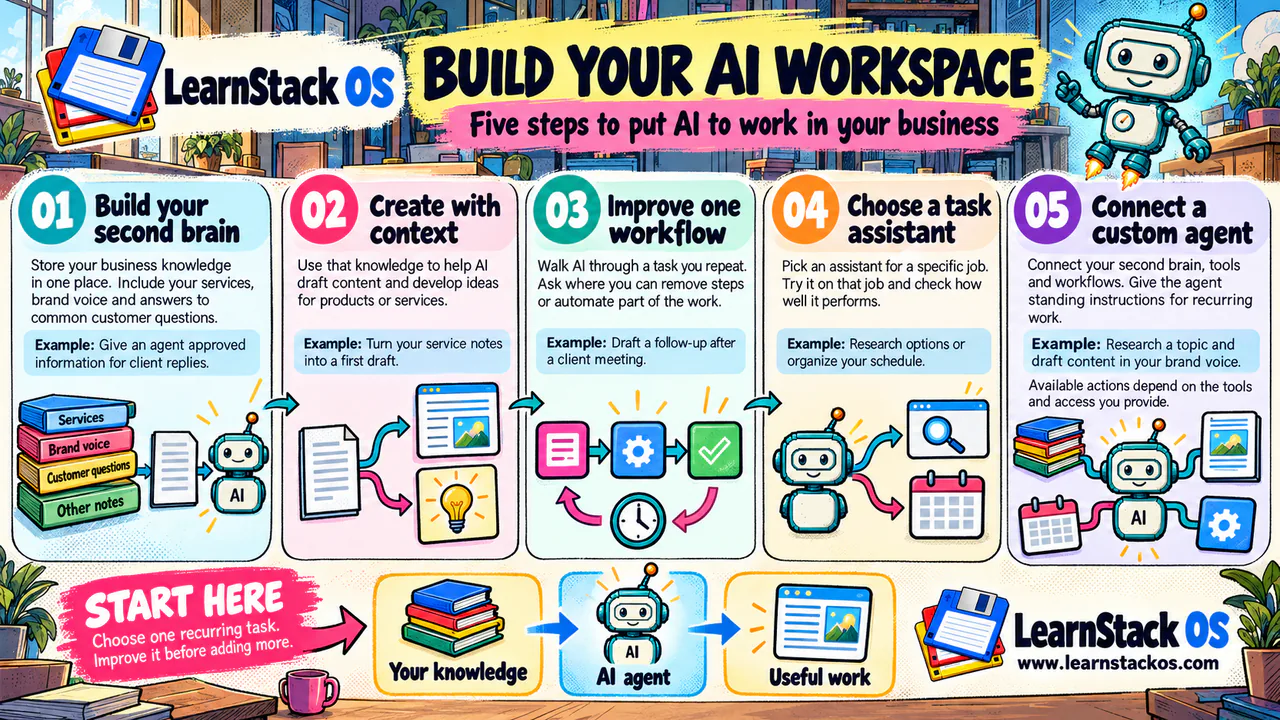
If you’re trying to work out where to start, I’d approach it in this order:
Give AI somewhere to learn about you.
Put what you know about your business in one place. Include your services and the work that shows what you know. Add how you want your brand to sound.
Call it your “digital twin” or “second brain.” The useful part is connecting an agent to it. That gives it information to draw from when it drafts client emails or answers customer questions.
You shouldn’t have to explain your whole business every time you open a chat.
Use that information to help you create.
Give tools from OpenAI or Claude the background they need to help you write content and develop products or services.
This is where the first step starts to pay off. Your agent has something specific to work with, including what you offer and who you want to reach.
Look at the work you repeat.
Walk AI through a normal day. Include the small jobs you’ve done so often that you barely notice them anymore.
Ask where you could cut steps or automate part of the work. Pick one task and try the suggested process.
Get help with specific tasks.
Explore assistants such as Muse, GrokBot or Dots, and Duet when it becomes available. Choose one based on a job you need help with. Give it that job and see how it performs.
Connect the pieces with a custom agent.
This is the part I’m most interested in.
An agent connected to your second brain can use your business information and follow workflows you’ve already defined. You can give it standing instructions instead of writing a detailed prompt each time.
With a setup such as Hermes, what it can do depends on the tools and access you give it. That might include research or shopping. Other tasks could include arranging deliveries and booking appointments.
The dry cleaning still needs someone to pick it up. Finding a cleaner and arranging a collection is another matter.
I think waiting carries a cost. While you wait, other people are learning which jobs they can hand over and where they still need to stay involved.
I’d start now with one recurring task. Something you already wish someone else would take off your hands.